The madhyamacharitam which we explored during the previous navarAtram ended with devastuti, where devas shower praises over mahishAsuramardini. Now we move on to uttamacharitram, which begins in the 5th adhyAya. This adhyAya consists of 129 shlokas in anushtubh chandas, and we will not be able to complete the entire adhyAya in one post.
The dhyAnashloka about saraswatI is interesting since it depicts her as shumbhAdidaityArdinI (the slayer of rAkshasas like shumbha). This is different from the depiction of saraswati which we are used to.
In the dhyAnashloka, saraswati is depicted as the one holding a bell, trident, plough, conch, pestle, chakra, bow and arrow.
The dhyAnashloka about saraswatI is interesting since it depicts her as shumbhAdidaityArdinI (the slayer of rAkshasas like shumbha). This is different from the depiction of saraswati which we are used to.
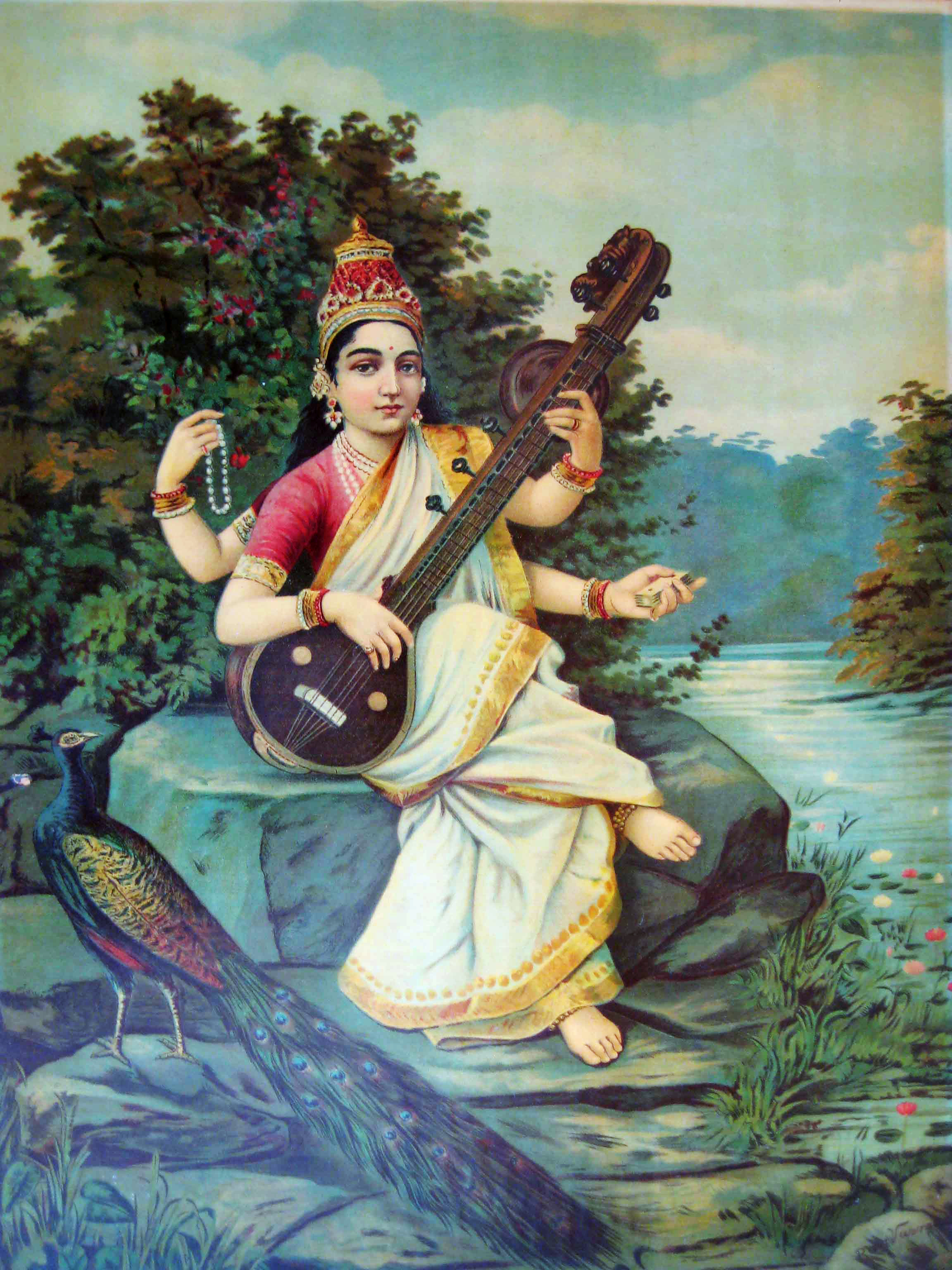 |
| ravi varma's saraswati who is the saraswati that comes to mind immediately |
घण्टाशूलहलानि शङ्खमुसले चक्रं धनुस्सायकं कस्ताब्जैर्दधती
These are totally different from the veena vAdini depiction above, and more of a veera-saraswatI.
The charitam starts by describing how two very powerful and wicked rAkshasAs called shumbha and his brother nishumbha defeated indra and banished all the devas from devaloka.
पुरा शुम्भनिशुम्भाभ्याम् असुराभ्यां शचीपतेः। त्रैलोक्यं यज्ञभागास्च ह्रतामदबलाश्रयात्।
After they started performing the roles of surya, chandra, vAyu, and all the other devas, the devas went to himAvAn, the king of all mountains and prayed to his daughter pArvatI. Earlier, she had promised to remove their obstacles should such a time come.
तयास्माकं वरो दत्तो यथापत्सुस्मृताखिलाः। भवतां नाशयिष्यामि तत्क्षणात् परमापदः।
The praises the devas sing there are probably the most famous verses from the entire saptashatI. These are the famous shlokas that start with yA devI sarva bhUteshu and end with namastasyai. namastasyai, namastasyai namonamaH.
देवाः ऊचुः *
...
या देवी सर्वभूतेषु विष्णुमायेति शब्दिता। नमस्तस्यै नमस्तस्यै नमस्तस्यै नमो नमः।
(The devI who is called vishNumAya in all beings, salutations to her salutations to her salutations to her)
या देवी सर्वभूतेषु चेतनेत्यभिधीयते। नमस्तस्यै नमस्तस्यै नमस्तस्यै नमो नमः।
(The devI who is called consciousness in all beings, salutations to her salutations to her salutations to her)
या देवी सर्वभूतेषु बुद्धिरूपेण संस्थिता। नमस्तस्यै नमस्तस्यै नमस्तस्यै नमो नमः।
(The devI who is resides in all beings as intelligence, salutations to her salutations to her salutations to her)
The praises proceed for 20+ shlokas where devi is described as the shAnti, shraddhA, dayA, tushTi, lakshmi, etc in all living beings.
* Digression: When we hear sentences like arjunauvAcha, or shrI bhagavAnuvAcha, or yudhishtirauvAcha, it simply means arjuna said, shri krishnA said, yudhiSthira said etc. UchuH is just plural for uvAcha since there are more than 2 devas.
When pArvati (the daughter of parvata), was going to ganga for her bath, she heard the prayers of the devas. At that time, kaushikI emanated from pArvatIs body and spoke to the devas. Two rAkshasAs called chanda and munda see devI's beautiful form and report this to their master shumbha.
O lord of the daityAs this devI is a jewel among women. You should see her. Her limbs are extremely captivating, and make all the directions glow.
स्त्रीरत्नमतिचार्वङ्गी द्योतयन्ती दिशस्त्विषा । सा तु तिष्ठति दैत्येन्द्र तां भवान् द्रष्टुम् अर्हति।
There is then a very beautiful description of what all shumbha lords over, and what all treasures the brothers and their armies stole from the devas. The celestial elephant airAvata, pArijAta tree, hamsavimAna, varuNa's umbrella, kubera's great lotus, and many more.
The dUta said (dUta uvAcha) -- O devI, I the messenger come in front of you, sent by shumbha, who is the lord of the daityas and the lord of the three worlds.
A mildly interesting samAsa vigraha is below.
निर्जिताखिलदैत्यारिः -- निर्जिताः (पराजिताः) अखिलाः दैत्यारयः येन सः निर्जिताखिलदैयारिः, शुम्भः
The three worlds belong to me and the devAs are under my control. I consume every single one of the sacrifices that is meant for them.
The rAkshasa asks the devi to marry either him or his brother, which one can find strange. But he is a rakshasa drunk on power, with a fair amount of rajas and tamas. So this is not entirely unexpected.
In this playful visual depiction, devI is shown seated on her throne listening patiently to the asura-messenger of the mahAsura-shumbha. The dUta is shown to be speaking haughtily, while also being soft.

The devI is inspired by this painting of the inimitable keshav-ji.

When in doubt, we use this excellent book as a reference https://archive.org/stream/saptashati-7-teeka-1/saptashati-7-teeka-2#page/n67/mode/2up .
It has 6 tIkAs (or commentaries) of which we find shAntanavI to be the most verbose and useful).
After they started performing the roles of surya, chandra, vAyu, and all the other devas, the devas went to himAvAn, the king of all mountains and prayed to his daughter pArvatI. Earlier, she had promised to remove their obstacles should such a time come.
तयास्माकं वरो दत्तो यथापत्सुस्मृताखिलाः। भवतां नाशयिष्यामि तत्क्षणात् परमापदः।
The praises the devas sing there are probably the most famous verses from the entire saptashatI. These are the famous shlokas that start with yA devI sarva bhUteshu and end with namastasyai. namastasyai, namastasyai namonamaH.
देवाः ऊचुः *
...
या देवी सर्वभूतेषु विष्णुमायेति शब्दिता। नमस्तस्यै नमस्तस्यै नमस्तस्यै नमो नमः।
(The devI who is called vishNumAya in all beings, salutations to her salutations to her salutations to her)
या देवी सर्वभूतेषु चेतनेत्यभिधीयते। नमस्तस्यै नमस्तस्यै नमस्तस्यै नमो नमः।
(The devI who is called consciousness in all beings, salutations to her salutations to her salutations to her)
या देवी सर्वभूतेषु बुद्धिरूपेण संस्थिता। नमस्तस्यै नमस्तस्यै नमस्तस्यै नमो नमः।
(The devI who is resides in all beings as intelligence, salutations to her salutations to her salutations to her)
The praises proceed for 20+ shlokas where devi is described as the shAnti, shraddhA, dayA, tushTi, lakshmi, etc in all living beings.
* Digression: When we hear sentences like arjunauvAcha, or shrI bhagavAnuvAcha, or yudhishtirauvAcha, it simply means arjuna said, shri krishnA said, yudhiSthira said etc. UchuH is just plural for uvAcha since there are more than 2 devas.
When pArvati (the daughter of parvata), was going to ganga for her bath, she heard the prayers of the devas. At that time, kaushikI emanated from pArvatIs body and spoke to the devas. Two rAkshasAs called chanda and munda see devI's beautiful form and report this to their master shumbha.
O lord of the daityAs this devI is a jewel among women. You should see her. Her limbs are extremely captivating, and make all the directions glow.
स्त्रीरत्नमतिचार्वङ्गी द्योतयन्ती दिशस्त्विषा । सा तु तिष्ठति दैत्येन्द्र तां भवान् द्रष्टुम् अर्हति।
There is then a very beautiful description of what all shumbha lords over, and what all treasures the brothers and their armies stole from the devas. The celestial elephant airAvata, pArijAta tree, hamsavimAna, varuNa's umbrella, kubera's great lotus, and many more.
O lord of the daityAs you have captured all these precious jewels. Why can't this jewel among women, this kalyANI be captured by you?
एवं दैत्येन्द्र रत्नानि समस्तानि आह्र्तानि ते। स्त्रीरत्नम् एषा कल्याणी त्वया कस्मात् न गृह्यते।
Having heard these flattering words, and after getting his ahankAra inflated, shumbha instructs a messenger to go talk to devI. He instructs him on what to say and how to say it. He then asks the messenger to speak softly and accomplish the task quickly.
इति च इति च वक्तव्या सा गत्वा वचनान् मम। तथा च अभ्येति सम्प्रीत्या तथा कार्यं त्वया लघु।
The dUta said (dUta uvAcha) -- O devI, I the messenger come in front of you, sent by shumbha, who is the lord of the daityas and the lord of the three worlds.
दूत उवाच
देवि दैत्येश्वरः शुम्भः त्रैलोक्ये परमेश्वरः । दूतः अहं प्रेषितः तेन त्वत्सकाशम् इह आगतः।
Listen to the words told by him, the one whose rule is uninterrupted by all the devas, who has conquered all the enemies of the daityAs
अव्याहताज्ञः सर्वासु यः सदा देवयोनिषु। निर्जिताखिलदैत्यारिः सः यत् आह श्रुणुश्व तत्। A mildly interesting samAsa vigraha is below.
निर्जिताखिलदैत्यारिः -- निर्जिताः (पराजिताः) अखिलाः दैत्यारयः येन सः निर्जिताखिलदैयारिः, शुम्भः
The three worlds belong to me and the devAs are under my control. I consume every single one of the sacrifices that is meant for them.
मम त्रैलोक्यं अखिलं मम देवाः वशानुगाः। यज्ञभागन् अहं सर्वान् उपाश्रामि पृथक् पृथक्।
All the great treasures of the three worlds are under my control. I have taken away indrA's elephant, the great airaAvata.
त्रैलोक्यवररत्नानि मम वश्यान्यशेषतः। तथा एव गजरत्नं च हृतं देवेन्द्रवाहनम्।
The best among horses called ucchaishravas, which came from the churning of the ocean of milk was submissively given to me by the amarAs (devAs).
क्षीरोदमथनोद्भूतम् अश्वरत्नं मम अमरैः। उच्चैश्रवससंज्ञं तत् प्रणिपत्य समर्पितम् ।
O beautiful one, whatever treasures the devas, gandharvas and nAgAs (uraga=nAga) had, they are all with me.
यानि चान्यानि देवेषु गन्धर्वेषु उरगेषु च। रत्नभूतानि भूतानि तानि मयि एव शोभने।
We think that you are the treasure among women. Since we have all the other treasures, you should come to us now.
स्त्रीरत्नभूतां त्वां देवि लोके मन्यामहे वयम् । सा त्वम् अस्मान् उपागच्छ यतः रत्नभुजः वयम्।
O devi, the one with the fickle gaze, since you are a treasure, honor either me or my brave brother nishumbha.
मां वा मम अनुजं वा अपि निशुम्भं उरुविक्रमम्। भज त्वं चञ्चलापाङ्गि रत्नभूतासि वै यतः।
Through me, you will obtain all the riches. Mull over this and come to me in marriage.
परमैश्वर्यम् अतुलम् प्राप्स्यसे मत् परिग्रहात्। एतत् बुध्या समालोच्य मत्परिग्रहताम् व्रज।
The rAkshasa asks the devi to marry either him or his brother, which one can find strange. But he is a rakshasa drunk on power, with a fair amount of rajas and tamas. So this is not entirely unexpected.
In this playful visual depiction, devI is shown seated on her throne listening patiently to the asura-messenger of the mahAsura-shumbha. The dUta is shown to be speaking haughtily, while also being soft.

The devI is inspired by this painting of the inimitable keshav-ji.
When in doubt, we use this excellent book as a reference https://archive.org/stream/saptashati-7-teeka-1/saptashati-7-teeka-2#page/n67/mode/2up .
It has 6 tIkAs (or commentaries) of which we find shAntanavI to be the most verbose and useful).

Nice. As we are so used to `D'evi, `L"ord etc., devi, lord appear different. there is a typo at one place. `is' ... `s'.
ReplyDelete